Guide · Coverage · Core and Extended
Higher coverage, higher grades.
Your exam can only ask what your lecture taught. In Auto, a quiz starts with one question for every must-know fact in the lecture plus a few Extended questions, instead of a fixed count or a hundred-question wall. Finish them and Generate more writes the next set from the facts you have not been tested on yet. Flashcards size themselves to the lecture, and Study Guides work through every section. Every question and card is ranked Core or Extended, so you study the must-knows first and keep going until nothing is left uncovered.
Auto quizzes and flashcards run on your own free Google Gemini API key, which takes about 10 seconds to add.
§ 1 · Coverage, measured
How much of the lecture Auto reaches.
We list every examinable fact in a lecture by hand, generate in Auto, and count how many of those facts the output actually tests or explains. These are the latest internal results.
-
Study Guide
94–98%
Of a 93-fact list: 94% for Brief, about 98% for Default.
-
Quizzes · Auto
89%
Of the lecture's examinable facts, with about half the questions written harder.
-
Flashcards · Auto
95–99%
One card for each examinable fact, sized to the lecture, with no padding.
Internal testing, October 2026, on one sample lecture. Coverage varies with the deck, and these figures are not a guarantee for every lecture.
§ 2 · How an item earns Core
Your lecture decides what is Core.
Memoraful reads every slide of a lecture, every bullet, table row and diagram label, and lists each testable fact. A fact is Core when an exam is most likely to ask it: a key number or range, a step or layer sequence, an indication or contraindication, what a procedure requires or must avoid and why, a cause of failure, a key comparison. Core is selective, about one fact per content slide across a lecture.
Every other fact worth knowing, a definition, a classification, a secondary detail, is Extended. The same ranking is applied to Auto quizzes and Auto flashcards, so a must-know fact is Core whether you meet it as a question or as a card.
Core
The facts your lecture flags, and the ones that decide management.
- Sympathetic preganglionic neurons sit in the lateral horn, T1 to L2.
- Ptosis, miosis and anhidrosis: Horner syndrome.
Extended
Adds every other fact worth knowing: definitions, classifications and secondary details.
- Astrocyte end-feet are part of the neurovascular unit.
- The corpus callosum connects the two hemispheres.
§ 3 · Studying by level
Pick a level. Nothing is deleted.
Levels only choose what to study. Every question and card stays, and every answer you give is kept.
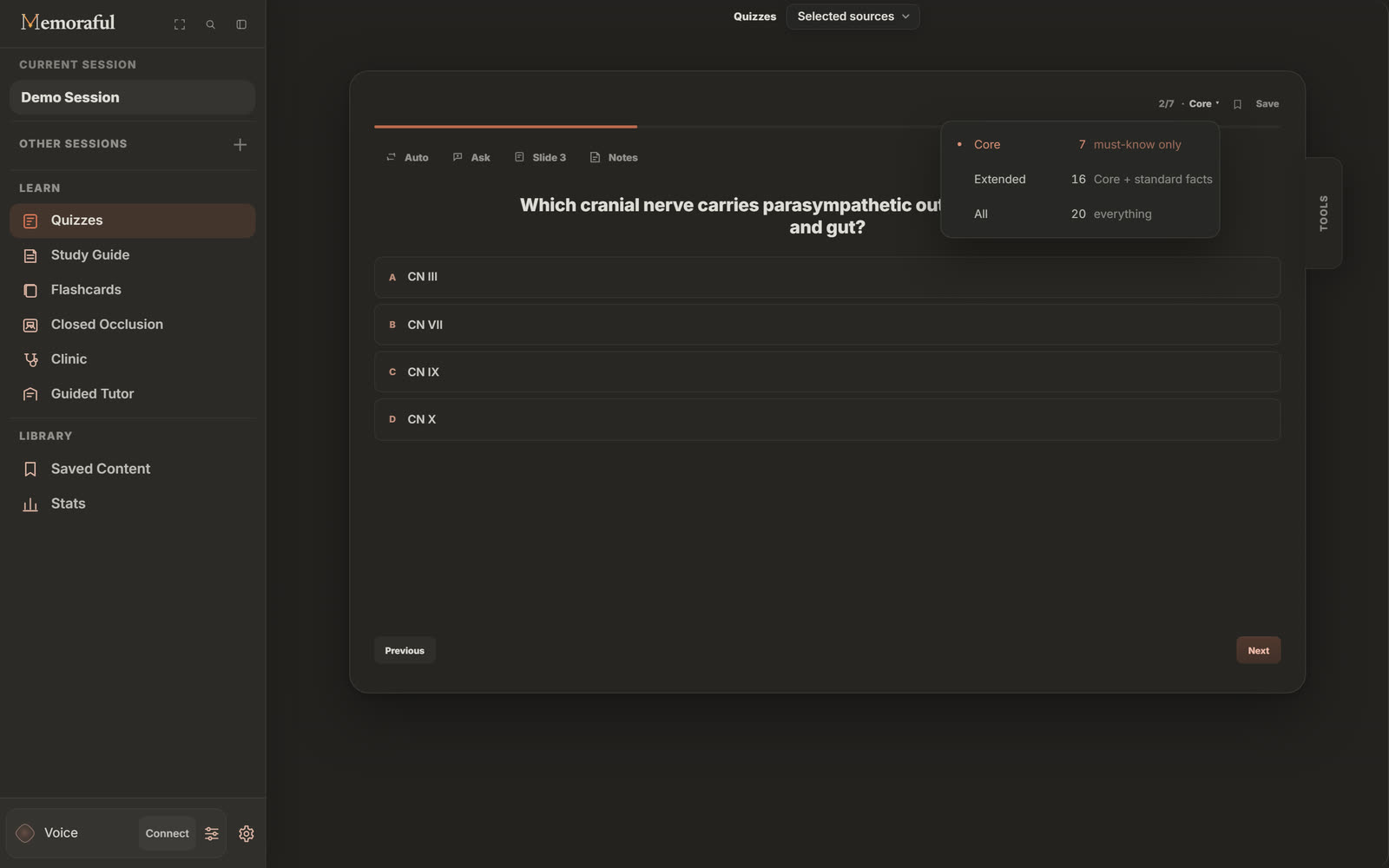
- The picker shows the size of the job.Core and Extended each show how many items they hold, so you know before you start how long tonight is.
- Quizzes and flashcards share it.The same picker sits beside the question counter on a quiz and beside the heading of a flashcard review.
- Moving up keeps your place.Items a higher level adds join after the ones you have already seen. Nothing you have answered is reshuffled.
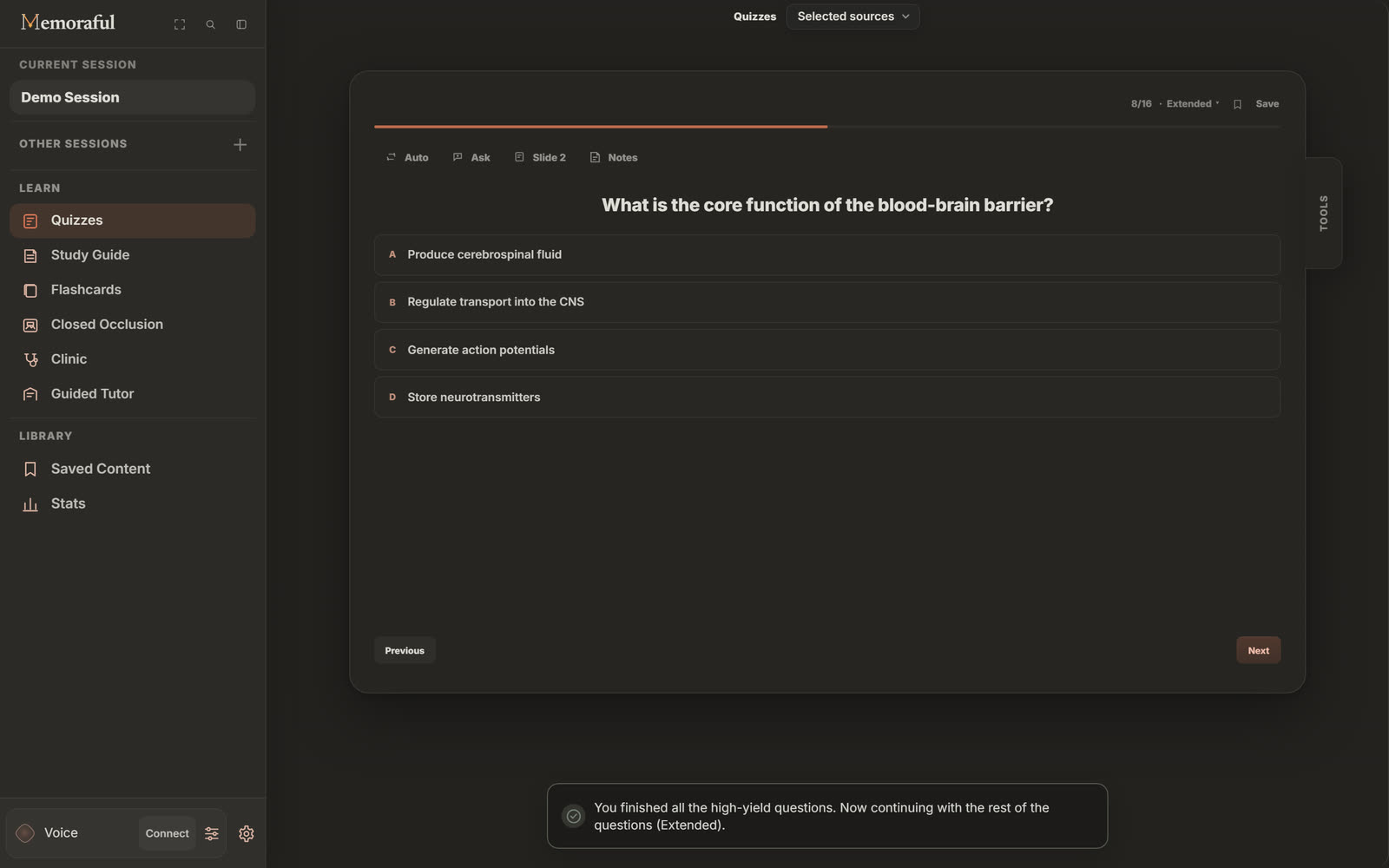
- Finish Core and it keeps going.Answer the last Core question and Memoraful tells you, then carries straight on into Extended at the next new question while it writes the next set in the background.
- Generate more when you want more.The next set tests the facts you have not seen yet, then new angles on the Core ones. New questions join the same quiz as they arrive.
§ 4 · Finding things
Anything you missed is one search away.
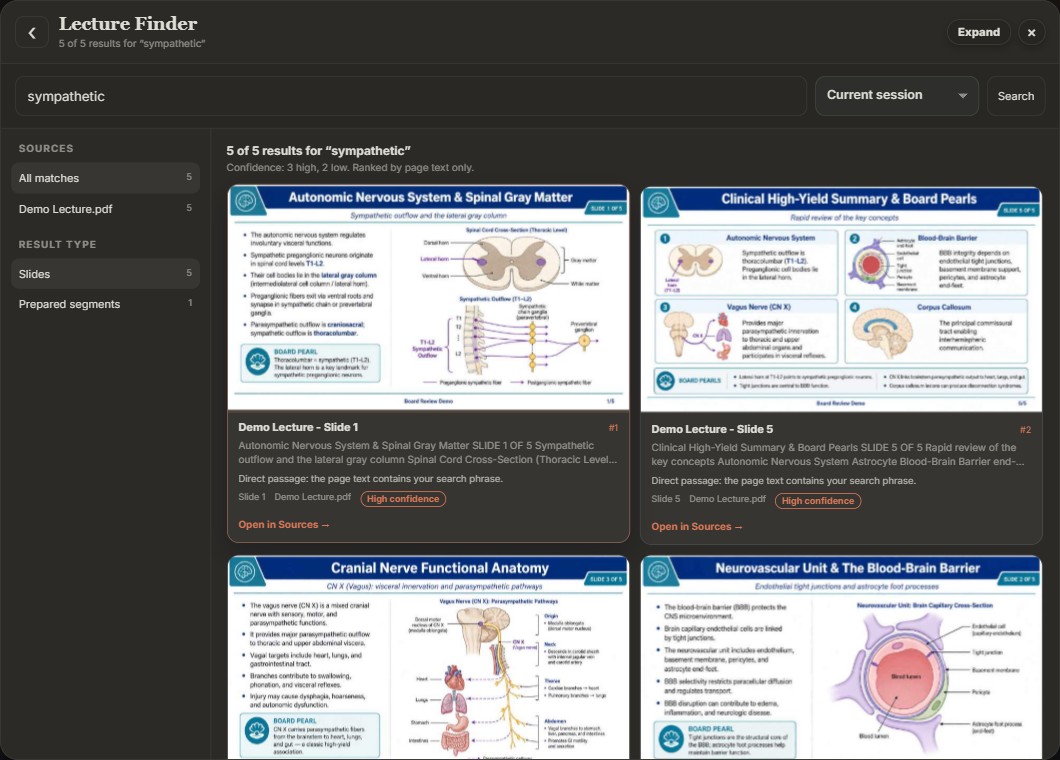
Coverage only helps if you can get back to the source. Lecture Finder searches, and the file viewer opens the slide beside what you are studying.
Search
Lecture Finder
Type a term, a table or a factor and Lecture Finder returns the slides that cover it. Search your lecture files or your quiz questions, in the current lecture, the current session or every session.
- Views for Slides, Images, Artifacts, Transcript and My Notes.
- Expand it to read results at full size.
- Ask Memoraful or Voice can open it for you: say what you are looking for.
Browse
File viewer
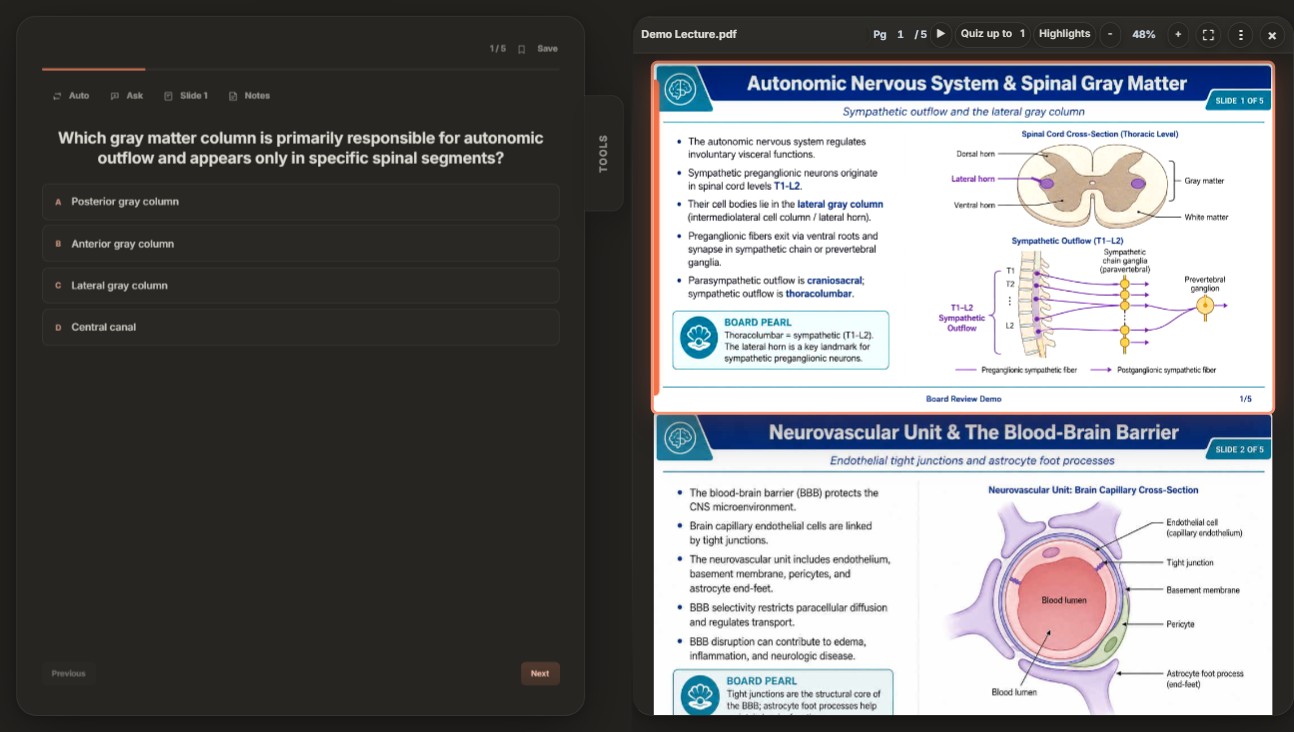
Your slides, PDFs and Word files open right beside the quiz or flashcard you are on, at the page the item was written from.
- Page through the deck or jump straight to a page number.
- Opening a source from Ask, a Study Guide citation or a search result lands on the same page.
- Keep the lecture open while you study, instead of switching windows.
§ 5 · A plan for the week before
Three passes, two levels.
One way to use the levels when an exam is a week away. It works the same for a pharmacology block, an organic chemistry midterm or a constitutional law final.
| When | Level | What you are doing |
|---|---|---|
| A week out | Extended | Read the Study Guide, then work through Core and Extended and generate more sets until every fact has come up once. Save what is unfamiliar and let Auto-save keep what you miss. |
| Three days out | Extended | Everything you have generated. Run it as a timed block in Exam mode and review the flashcards at the same level. |
| The night before | Core | Only the must-knows, as questions and as cards, then Hard mode on anything you still miss. |
Where the levels come from. Core and Extended come with Auto quizzes and Auto flashcards, which run on your own free Google Gemini API key. Adding one takes about 10 seconds. Quick (10 questions) and Standard (25) quizzes are free without a key and are not ranked.
§ 6 · Questions
Before you rank a lecture.
How was coverage measured?
In our own testing we listed every examinable fact in a sample lecture by hand, generated in Auto, and counted how many of those facts the output tested or explained. The figures are from internal runs on one lecture, not a guarantee for every deck.
Is this the same as a high-yield list from a review book?
No. Memoraful ranks your own lecture by what your lecture emphasizes, so the levels follow the person who wrote your exam rather than a general syllabus.
What if my slides never say high-yield?
Core does not depend on the label. It holds the facts an exam is most likely to ask: key numbers and ranges, steps and sequences, indications and contraindications, requirements and the reasons for them, causes of failure and key comparisons. Everything else worth knowing is Extended.
Do levels delete questions, cards or progress?
No. A level only chooses what you study. Every question and card stays, and every answer you give is kept.
Do I need my own key?
Yes. Core and Extended come with Auto quizzes and Auto flashcards, which run on your own free Google Gemini API key. Adding one takes about 10 seconds. Quick and Standard quizzes, which are free without a key, are not ranked.
Does it work for courses outside medicine?
Yes. Emphasis, repetition and summary slides are how lecturers in every subject signal what matters, from chemistry and engineering to law and history.
More guides
Keep going.
Cover the whole lecture.
Bring a lecture, make it in Auto and study Core tonight.